Monday, 30 April 2018

Delhiites, you may soon be able to book your parking slot on app, use Wi-Fi on the move

NEW DELHI: New Delhi Municipal Council (NDMC) will soon develop as its roads as ‘smart roads’ under the Smart City project of the Union government. These roads will have special features like landscaping, vertical gardens, cycle tracks, street furniture, plazas/eateries, pelican crossing and 3D zebra crossings.


NDMC has selected three roads — Mother Teresa Crescent road, Janpath road and Sansad Marg — to develop. Senior officials claimed that the council is preparing the tender and a consultant has been appointed to submit the design.

“The concept of smart roads is to provide better facilities on a particular stretch like open-air cafeteria, landscaping, street furniture, etc. The project will also see replacing street lights with LED lights, with the smart poles having Wi-Fi facility,” said a senior NDMC official.

The plan was first proposed by union minister Venkaiah Naidu in January last year. At the time, it was also proposed to make Connaught Place a vehicle-free zone. However, the Connaught Place plan didn’t take off due to objections from the New Delhi Traders Association and lack of preparations from the NDMC. However, senior officials pointed out that work has been initiated for the smart road project and blueprint is already ready for Mother Teresa Crescent road.

“Once the designs are approved by the council, we will float the tender to award the work. The scope of funding is yet to be decided by the council, which will happen only after the designs are ready,” said a senior NDMC official.

At Mother Teresa Crescent road, the work to develop street furniture has been awarded to SAIL and the work for developing pelican crossing will be done in consultation with the traffic police, officials added.

The smart roads will have sensor-based smart parking system as well. People can book the slot using NDMC 311 mobile app at any desired location in advance and pay through e-wallet or internet banking. The work has already been awarded to a private firm, officials said.

NDMC has procured 60 smart poles, which will have facilities like Wi-Fi, CCTV camera, environment sensors and warm LED. Along with smart poles, these roads will have digital interactive information panels. People can use this panel for registering any complaints with NDMC and also can avail services online.

10 companies have exited Indian smartphone in 2018 so far

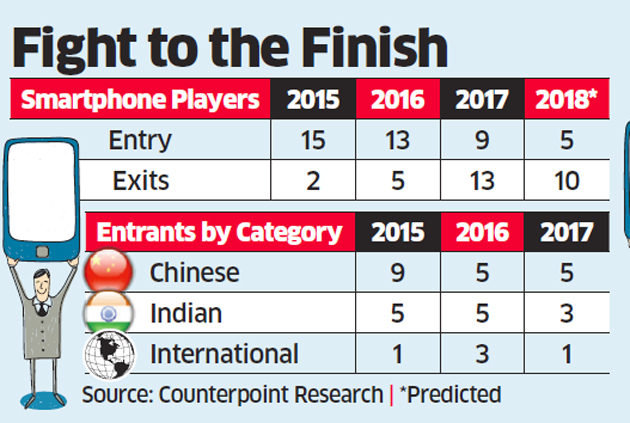
NEW DELHI: The shakeout in India’s smartphone market mirroring the telecom industry saw number of new entrants nearly halved between 2015 and 2017 while exits grew six-fold as the capital intensive business weeded out weak players unable to sustain and expand as competition capped prices.

The top five smartphone brands — Xiaomi, Samsung, Oppo, Vivo and Huawei — currently control over 72% of the market against 63% in 2015, albeit with a different brand combination. The top 15 have cornered over 90%, of the market according to Counterpoint Research and experts believe exits and consolidation will gather pace this year.


Singapore-based research firm Canalys data showed that the top five — Xiaomi, Samsung, Oppo, Vivo and Lenovo — had about 77% of the smartphone market in the March quarter and Micromax, Intex and Lava, the three Indian players in the list in 2015, fell off. “The fast changing dynamics and fierce competition in the India smartphone market will lead towards consolidation in the market,” said Shobhit Shrivastava, research analyst at Hong Kong based Counterpoint Research.

Counterpoint sees some five new entrants in 2018 versus 10 exits. Analysts say roughly 15 of the total 50-60 have the required strength or a niche strategy to stay for the long run. Some of the notable players not in the top five include Apple, Motorola/Lenovo, Nokia, OnePlus, and Lyf besides local players such as Micromax and Lava. At its peak in 2014-15, the mobile phone market had over 300 smartphone players.

“Smaller players are struggling to set up local level manufacturing, especially after the 10% duty on printed circuit board (PCB) assembly, since they don't have enough volumes to justify large investments. Due to competition, they cannot raise prices,” said Jaipal Singh, senior market analyst at International Data Corporation (IDC) India.

In 2015, of the 15 new players, nine Chinese and five Indian entered the smartphone growing at more than 20% every year and only one player exited. By 2016 when the market growth slowed to just 5%, 13 new players entered, five each of Indian and Chinese origin, and an equal number exited, Counterpoint data show. In 2017, when the market growth rebounded to about 14%, 13 players exited and only nine new players moved in, five of them Chinese.

The handset market reflect the telecom sector in India where the entry of disruptor Reliance Jio forced rampant tariff cuts and sparked the need for top dollar investments, triggering rapid consolidation that left only three main operators from 10-12 a couple of years back. Over 60% of the subscriber share and 70% of the revenue share was with the three top players – Bharti Airtel, Vodafone and Idea — even before the cull and the latter two merged.

On the smartphone front, disruptor and new No. 1Xiaomi and long-time leader and now No. 2 Samsung together cornered 58% of the market in the January-March quarter. “This is happening for the first time in a single quarter… could accelerate exits and possibly consolidation,” said Counterpoint research analyst Anshika Jain.

Sector watchers don’t expect the dominant players to loosen their grip on market share anytime soon as competition in the sub- Rs 10,000 segment – where most new players come in – has become tougher with the presence of Xiaomi. Besides, new players have to spend more on marketing, sales and distribution where margins have been slashed, commissions cut and shop floor employees eased out across brands.

“The sales channels have changed, there isn’t anyone now who can spend like Oppo and Vivo did, going into the deepest pockets and giving shopkeepers rentals to put up their glow signs. Now, even Oppo and Vivo have curtailed spends,” IDC’s Singh cautioned.

Apple India's net profit surges by 44% and so does its India ambition

KOLKATA: Apple grew its India net profit for the year ended March 2017 by 44% at Rs 373.4 crore, according to the Cupertino-based iPhone maker’s latest regulatory filings made to the Registrar of Companies (RoC).

Apple India’s pace of sales growth, however, came down significantly from 40%-plus it had reported for previous five years since the company increased its focus on India even as the Chinese smartphone brigade started polarising the Indian market.


Apple India’s total income (including other income) grew by 17% to touch Rs 11,704.5 crore in FY17, up from Rs 9,997.6 crore in the previous fiscal.

Analysts believe Apple will maintain its pace of profit growth in India in 2017-18 due to highly profitable models in its portfolio despite Chinese brands increasing their share to a record 57% of the total Indian smartphone market in the just concluded fiscal, up from 53% a year earlier, as per figures revealed by Hong Kong-based researcher Counterpoint.

Apple India has ploughed back its FY17 profit into the operations, which had aggregate surplus of Rs 1,556.5 crore as of March 2017. A senior industry executive said this will be used for further expansion of local operations.

Apple India’s filings made to RoC said no dividend was paid to the parent for the fiscal under review to conserve financial resources.

The company in the RoC filing said income and consequent profits are “increasing at a consistent pace”.

Emailed queries on the financial performance sent to Apple India did not elicit any response as of press time Sunday.

Analysts say Apple India’s sales growth will remain comparatively low in 2017-18 due to higher competition, with Chinese brand One-Plus gaining significant share in the premium segment and due to higher base effect.

“The financial performance for Apple India in the last fiscal will not be much different with one of the highest profitable models in the portfolio,” Counterpoint’s associate director Tarun Pathak said. “Their installed base and average selling price too are going up in India,” he said.

Counterpoint has analysed that Apple’s iPhone X model nabbed 35% of the global smartphone market’s profit during the October-December quarter, making it the most profitable smartphone followed by iPhone 8, with 19% of the industry’s profit, and iPhone 8 Plus with 15% profit share. In fact, Apple had earned 90% of the global industry’s profits during the quarter with its entire portfolio, as per the researcher.

In FY17, Xiaomi, Vivo and Oppo together had combined sales of Rs 22,527 crore, a near eight-fold jump from Rs 2,919 crore they reported in FY16, according to RoC filings.

Of the Chinese brigade, only Xiaomi is profitable in India with net profit of Rs 163.9 crore in FY17.

In the just concluded Jan-March quarter, Apple lost its leadership status in the Rs 30,000-plus segment to Samsung that captured half of the total market with its new launches, as per Counterpoint. One-Plus was in the second place with one-fourth share of the premium market, the researcher said.

Google celebrates Dadasaheb Phalke's 148th birth anniversary with Doodle

Google on Monday dedicated its creative doodle to mark the 148th birth anniversary of the father of Indian Cinema Dhundiraj Govind Phalke, popularly known as Dadasaheb Phalke.

Born on April 30, 1870, in Trimbak, Phalke gave Indian Cinema its first silent film, 'Raja Harishchandra' in 1913 with special effects, making it a huge hit.

He made 95 movies and 27 short films in his career spanning 19 years, till 1937.

"Created by guest artist Aleesha Nandhra, doodle shows a young Dadasaheb in action as he went about directing the first few gems in the history of Indian cinema," wrote the Google blog post.

"After stints as a painter, draftsman, theatrical set designer, and lithographer, he chanced upon Alice Guy's silent film, The Life of Christ (1910). Phalke resolved to bring Indian culture to the silver screen. He traveled to London to learn filmmaking from Cecil Hepworth," it added.

The Dadasaheb Phalke Award, for lifetime contribution to cinema, was established by the Government of India in 1969. The award is considered as one of the most prestigious awards in Indian cinema.

Baidu to sell majority of financial services unit for $1.9 billion

China's Baidu Inc said it will sell a majority stake in its financial services business for about $1.9 billion to a consortium led by TPG Capital Management LP and Carlyle Group LP, as it seeks funding to take on established fintech firms in China.

The investment will give Baidu the heft it needs to narrow the lead that rivals Alibaba Group Holding Ltd and Tencent Holdings Ltd have taken in financial services, and help Baidu's push to seek revenue streams outside its core internet search business.

The deal comes at a time when China's government is tightening regulations on the loans market to rein in shadow banking and push banks to cut bad debt.

Baidu's Financial Services Group (Baidu FSG) runs payment system Baidu Wallet, an online credit service and an online wealth management platform. It owns several small financial licenses such as a third-party payment licence and a fund sales licence.

Baidu will be left with a roughly 42% stake in the unit, renamed Du Xiaoman Financial, which will operate independently of Baidu. The rest of Du Xiaoman will be owned by the consortium that includes Taikang Group and ABC International Holdings Ltd, Baidu said.

Guang Zhu, senior vice president at Baidu and general manager of the current financial services business, will become chief executive of Du Xiaoman, Baidu said in a statement late on Sunday.


"In the coming age of FinTech, Du Xiaoman will leverage the technological capabilities of Baidu AI to partner with financial institutions and provide technology-driven, trustworthy financial services to consumers in China," Zhu said, referring to artificial intelligence.

Reuters reported in January that the Chinese search engine provider was seeking new investors for its wholly owned finance unit, in an up to $2 billion deal.

In a separate statement, TPG said, together with its co-investors, it would invest around $1 billion in the deal, which it expected to close in two to three months.

Baidu FSG, launched in 2015, had a loan balance of 28 billion yuan ($4.42 billion) at the end of 2017.

Google co-founder Sergey Brin has a message for AI fanatics


Alphabet President Sergey Brin said on Friday that technology companies must take greater responsibility for the social impact of their work, his first comments following a year of heightened global awareness about the misuse of digital services.

Brin delivered the message through Alphabet's annual shareholder letter, which he signed for the first time since 2014 instead of Chief Executive Larry Page.

"We're in an era of great inspiration and possibility, but with this opportunity comes the need for tremendous thoughtfulness and responsibility as technology is deeply and irrevocably interwoven into our societies," Brin wrote after quoting from Charles Dickens' novel "A Tale of Two Cities" about the "the best of times" and "the worst of times."

Alphabet's primary unit, Google, has become a top target in Silicon Valley for regulators, authorities, and critics in advertising and media. It has drawn global scrutiny for its dominance in online search advertising, its policies around user privacy and its role in helping politically consequential misinformation spread online.

Brin did not touch on those issues, nor did he specify any actions the company would take to recognise new responsibilities.


But Brin focused on artificial intelligence, computer systems that are able to learn without humans hard-coding them. Artificial intelligence enables self-driving cars and software that can identify diseases.

Brin said that Alphabet would tread with "serious thought and research" about societal consequences such as eliminating jobs and advancing biases as the company expands the use of artificial intelligence.

"While I am optimistic about the potential to bring technology to bear on the greatest problems in the world, we are on a path that we must tread with deep responsibility, care, and humility," he said.

Alphabet separately announced on Friday the details regarding its annual shareholder meeting, which it scheduled for June 6. The company recommended shareholders reject each of the seven proposals brought by investors that call for it to provide more information around gender pay disparity, environmental impact policies, content moderation and other issues.

Xiaomi Redmi S2 lists online, 'reveals' pricing

Xiaomi Redmi S2 has emerged on a promotional listing in Vietnam. The smartphone appears in an ad that shows its picture and price. The pictures are similar to the one that surfaced after the Xiaomi smartphone appeared in Chinese telecom regulator TENAA's listing.

As per the promotional ad in Vietnam, Redmi S2 appears to be a budget smartphone and is priced at $180 as per the listing (Rs 11,000). The listing further reveals that Xiaomi Redmi S2 will sport 18:9 display. From the pictures, it also appears that the smartphone will come sans physical Home buttons and likely feature a dual-camera setup at the top.

Xiaomi Redmi S2 is said to sport 5.99-inch screen with HD+ resolution of 1,440 by 720 pixels. The smartphone is said to come with 3000 mAh batter capacity. As per the TENNA listing, Xiaomi Redmi S2 will run Android 8.1 Oreo-based MIUI 9 out of the box. Several leaks also point to the smartphone being powered by Qualcomm Snapdragon 625 SoC.

The smartphone has already got certification from Chinese Compulsory Certification (CCC), the product testing agency in Xiaomi's home country. According to a report in Android Headlines, three models of the handset have been tested by CCC. These sport the model numbers -- M1803E6E, M1803E6T, and M1803E6C. The report also adds that one of these variants, with model number M1803E6E, also has been certified recently by TENAA.

Xiaomi recently launched Mi 6X smartphone in China. The smartphone is successor to the company's earlier-launched Mi 5X smartphone. In India, Mi 6X is expected to launch as successor to the company's first Android One smartphone Mi A1. Xiaomi Mi 6X features dual-rear cameras and runs on octa-core Snapdragon 660 SoC with Andreno 512 GPU. It comes in two variants, based on RAM capacity -- 6GB and 8GB.

Samsung Galaxy A8 (2018) Facing Loudspeaker Issues After Recent Update, Some Users Report

Samsung Galaxy A8 (2018) has been reportedly hit by a loudspeaker-related issue following a recent software update. Several users are co...